I started this essay while we were in Dublin a few weeks ago to celebrate Chad's birthday and just wrapped it up this morning. It's funny—the whole time we were in Dublin, Chad and Michaela kept commenting on how comfortable I seemed to be while we were there, almost like I could have been from there. And now, having written this, I think I understand why.
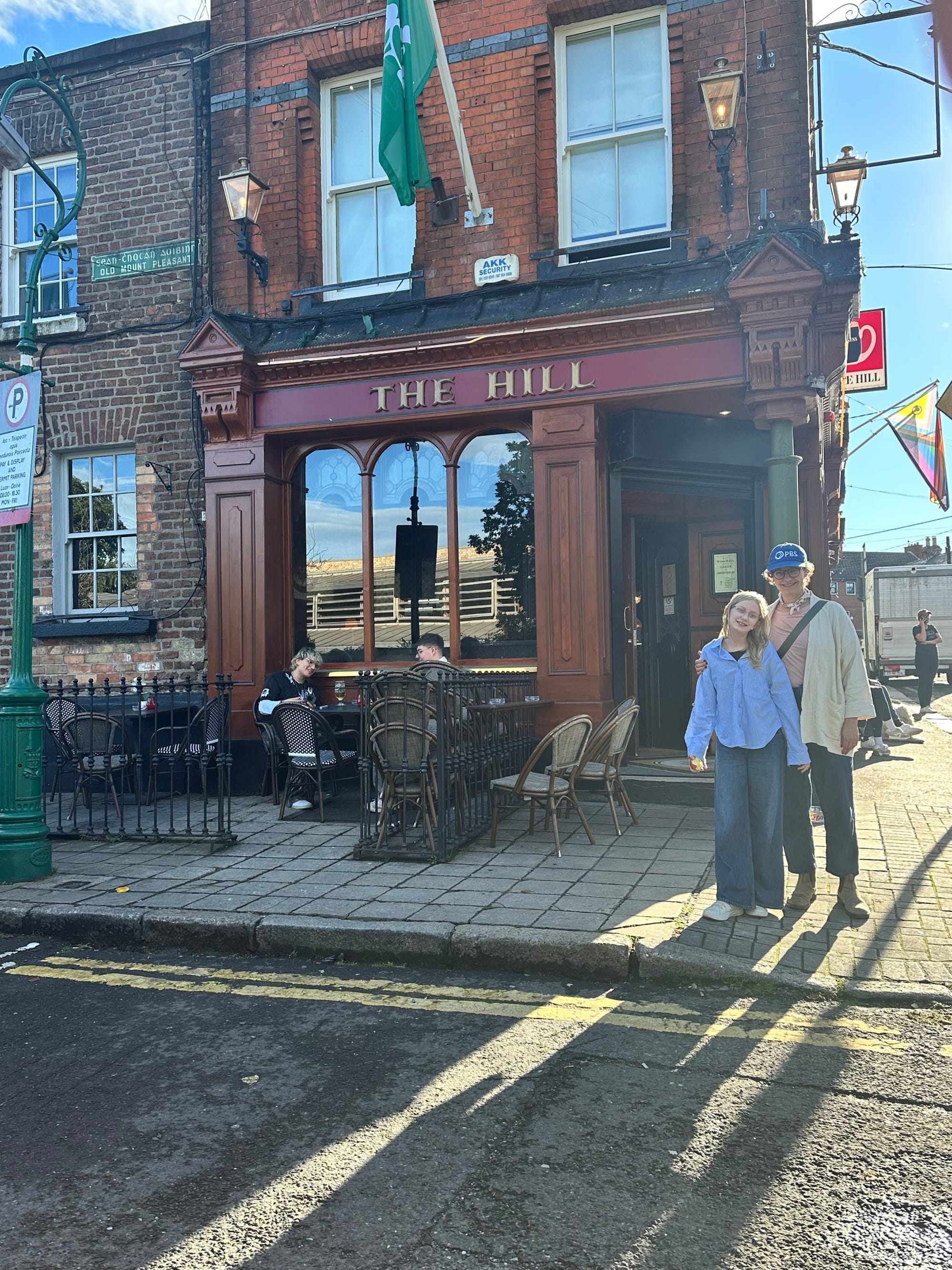
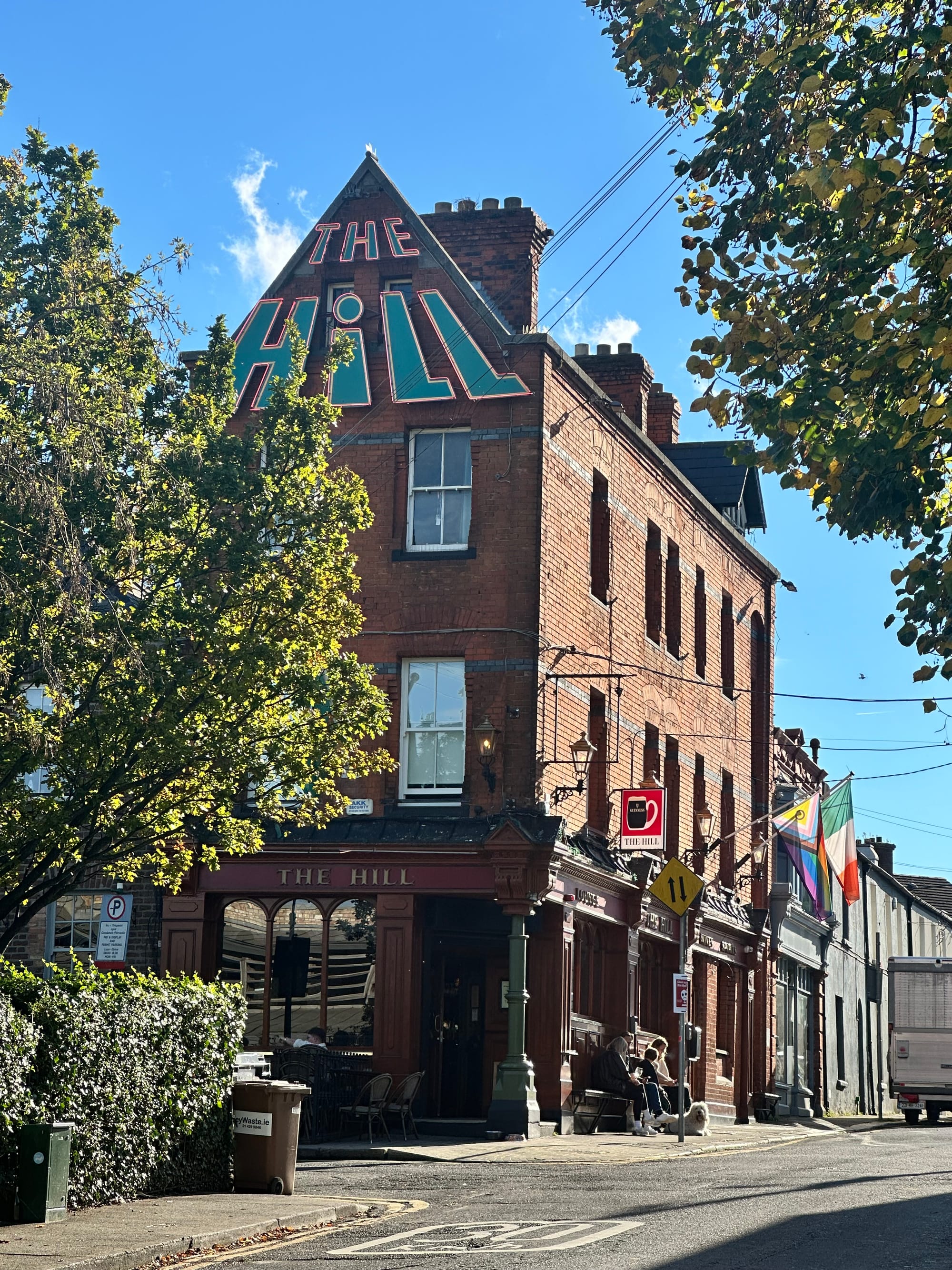
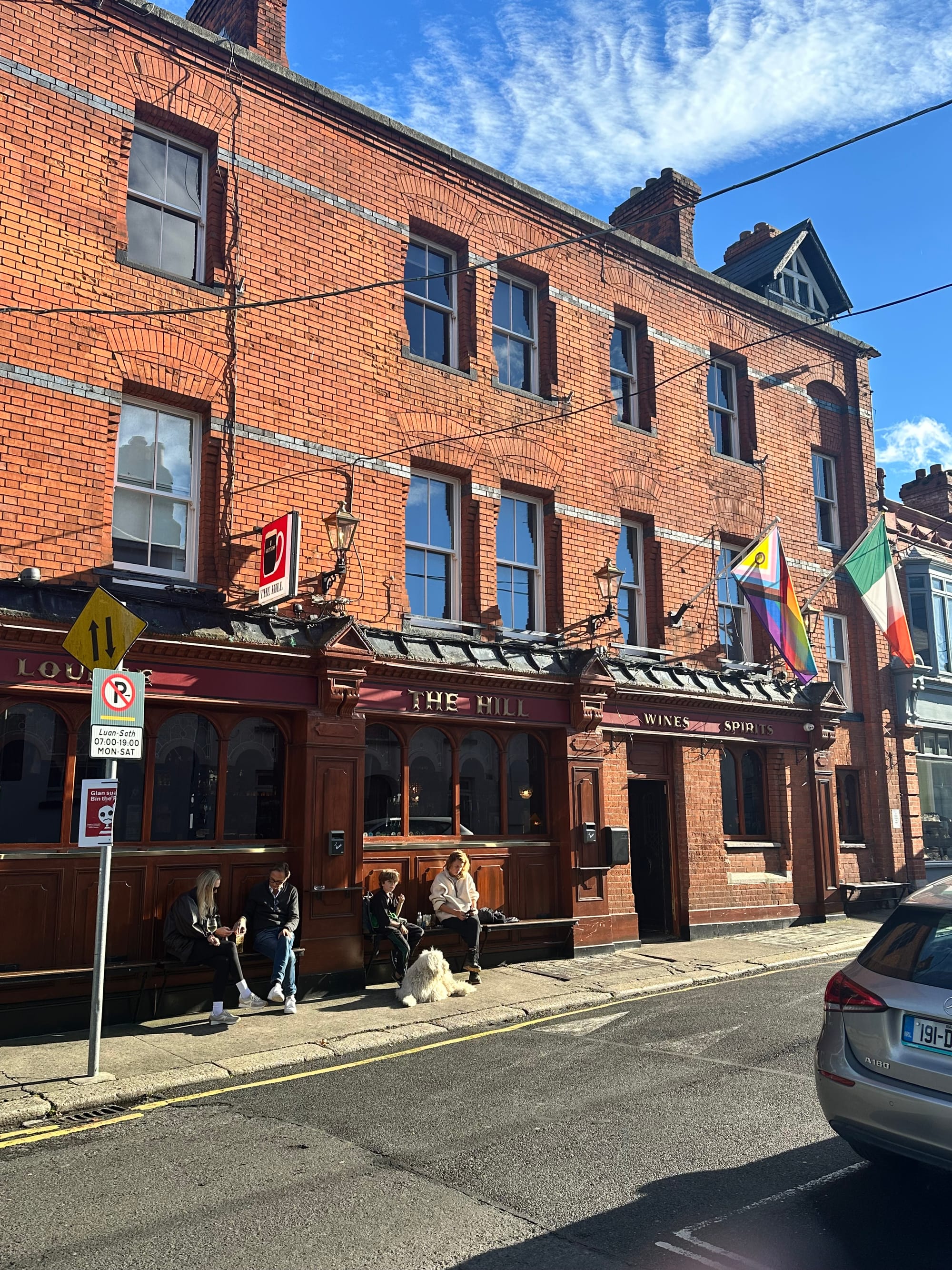
We didn’t go to Ranelagh until the last day of our trip. I think I postponed our going there because I was nervous. I didn’t want to see the pub where I’d worked boarded up. I’d read an article in the Irish Times about how it had closed. On Apple Maps it clearly stated: Permanently Closed. But when we found it, a short stroll from the Luas Station, the door was open and the lights were on. The young guy working behind the bar looked to be in his late twenties and was fighting a head cold. He told me the Hill had changed hands a couple of times, but that he had never known the Hill to be anything other than open. He sniffled as he poured me half a pint of Guinness and listened with professional courteousness while I expressed disbelief at finding the Hill not only open, but seemingly unchanged—unlike one of my favorite Dublin haunts, the Winding Stair bookstore, now reduced to a meek single floor of the original building. I told him about the family who had owned the pub when I worked there, a big family with several sons.
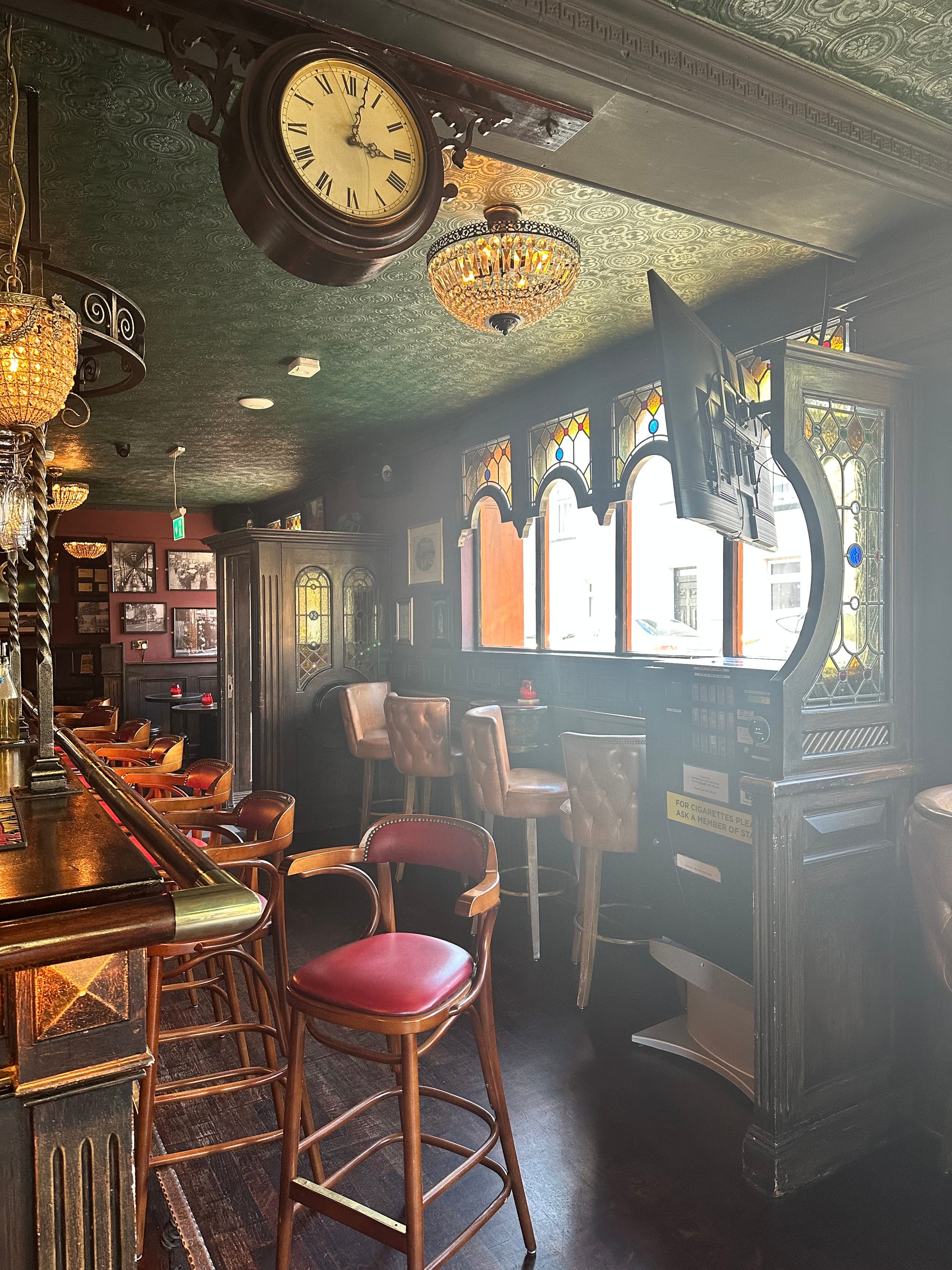
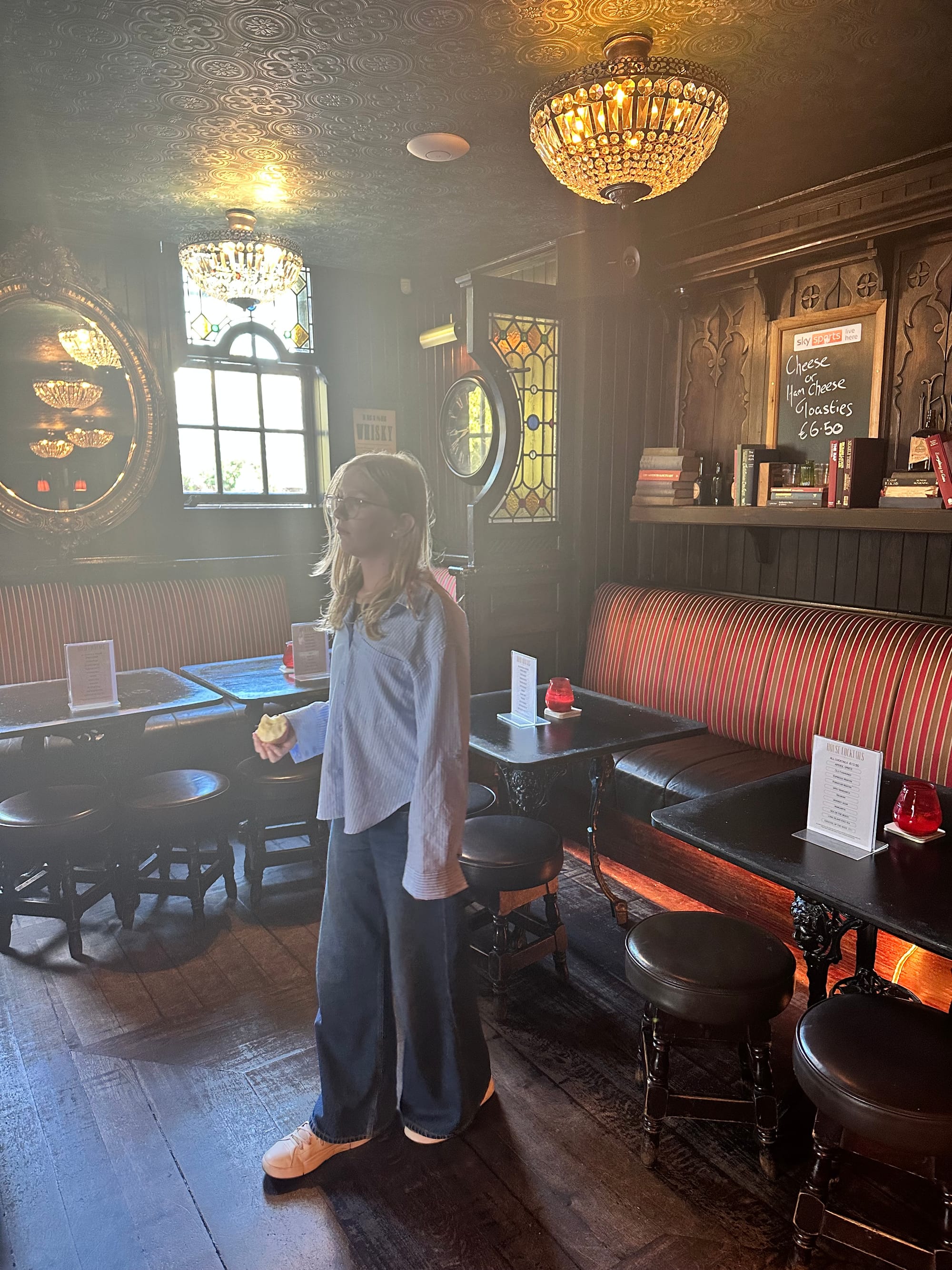
The young guy feigned interest, smiled, and brought me the Keogh’s Salt and Vinegar crisps I’d ordered. I paid for the Guinness and the bag of crisps and, while Chad found us a table outside, explored the rest of the pub with Michaela, finding it all exactly as I’d remembered. The massive wood bar dominated one side of the pub, while on the other side of the bar, separated by a wall, was a tall counter surrounded by stools and tables set into invitingly dark nooks.
It was the summer of 1996, and I don’t remember getting the job, only that it was easy to get. The uniform, which I had to buy for myself, was a black skirt and a white blouse. I worked for cash since I did not have a visa. Nobody tipped servers back then; the wages were decent, and healthcare was (and is) provided by the state. But everyone told me I’d get tips just because I was American, and the Irish knew that it was the custom to tip servers in the States. This was true, I did get tips. Most people were charmed by my American accent and sympathetic to my obvious inexperience. They knew I was far from home and felt sorry for me. I became complacent about getting tips and once hovered thoughtlessly over a customer after bringing him a Guinness. He was there on his own, which was unusual—the Hill was a social, lively pub, the kind of pub that families went to after mass, or where groups of friends met up. This man had a drawn, pinched face, and wasn’t able to make eye contact with me. Still I lingered, foolishly—I even asked if he was going to give me a tip, I really can’t believe I did that—and he blinked, still not making eye contact, and muttered irritably, “The Guinness is dear enough as it is!”
I quickly realized my faux pas, apologized and withdrew in shame. I was also charmed by his use of “dear” for “expensive,” which seemed quintessentially Irish to me. The next time I came by to check on him, he gave me a few pence, worth more to me—“dearer” to me—than the biggest tip I ever got.
What an easy, fun job! Nobody ever ordered anything complicated. I especially loved the shift after Sunday mass. Once two old ladies, prim and tidy in their Sunday best, came in and ordered two bottles of Guinness. I later asked my boyfriend about that—he was American, had studied in Dublin that year, and knew far more about beer than I. He said bottled Guinness tended to be more bitter, and some people preferred it.
The bar at the Hill was formidably wide. In my memory the bar was mounted on a platform, giving the bartender additional height, but I’m not sure that was actually the case. Yet whoever tended bar appeared powerful. The bar was a command station, and the bartender was the commander, controlling taps of Guinness, Smithwick’s, Carlsberg, ciders. I only went behind the bar to fill the water pitcher. Mounted on the wall behind the bar was a vast mirror, tarnished but still reflective. If the bartender turned around to get a bottle of gin, he need only glance at the mirror to see everything happening behind him.
I don’t remember meeting Aisling, who was the other waitress (nobody ever called us servers)—was it the same day I met Patrick, the son who seemed most likely to take over the Hill from his dad? Patrick, who had black hair, was generically handsome in a frat-boy sort of way. Like his dad, his manner was tense, watchful. But while the dad never looked me in the eye, Patrick did. His look was calculating and made me uncomfortable.
Aisling took a shine to me and gossiped lightly about Patrick and his brothers. There was minimal interaction between us and the bartenders—we told them our drink orders, they brought us the drinks, and at the end of our shift they opened the cash register and gave us our pay. Even the customers seemed both intimidated and put off by the taciturn father and his oldest son. Aisling told me that the owner had inherited the Hill from his own father, and that the dad never talked to anyone except his sons. She didn’t much like Patrick, though she never told me why.
Aisling invited me to tea once after a shift, and as I sipped my tea in her small sitting room, which smelled faintly of mothballs, she regaled me with stories of the small village where she’d grown up, and which she clearly missed. It was Aisling from whom I first learned of the existence of peat. The way Aisling described peat, it sounded more precious than gold. It certainly was more useful than gold. Peat did everything: it was fuel to cook with; material to build with (her family’s house was made of peat); soil in which whatever was planted grew terrifically well. I walked home dreamily, imagining cheerful, friendly Irish country folk sitting around a fire kindled from peat, eating baked potatoes grown in peat, inside their house of peat. The famine? The Troubles in the North? These seemed like stories of little import, stories from someone else’s Ireland. Mine was the Ireland on the rise, the “Celtic Tiger.” I could more easily picture leprechauns hiding beneath four-leaf clovers than I could IRA agents lurking in dark alleys. Or hunger strikes.
The next time I saw Aisling, the crowd at the Hill was reasonably relaxed. Not overly full, like after mass, when families squeezed together around the tables and little kids ran around. A group of well-dressed men came in. They looked business-y. No one wore suits to the Hill. These men did. They sat at a sunny table near a window and slung their suit jackets over their chairs. The color of their shirts was seasonally soft pastels—salmon pink or sky-blue. They rolled up their sleeves, revealing expensive watches. I went over to take their order, immediately clocking their British accents. I brought them their pints, and they handed me a large bill and told me to keep the change. I was agog. I never got tips this generous. It was at least two quid—a fortune. The next round was the same. “I have to tell Aisling,” I thought. She should have a chance to get a little extra, too.
“Aisling.” I caught her at the bar while she was waiting for her drink orders. “You see that table over there?” I pointed with my chin at the men sitting there laughing, downing their pints. Aisling glanced over at them, then looked straight ahead. She was silent.
“Aisling, you need to serve them,” I said in a low voice. “They’re giving me huge tips. They’re tipping in pounds.”
Aisling’s gaze was level. She still didn’t look at me. The bartender handed her the drinks, and she arranged them on her tray. Once she was satisfied with the balance of their weight, she took a breath. I assumed she was about to thank me. Instead, she said quietly but fiercely, “I wouldn’t take their order if they gave me a hundred quid.”
They left soon after, in any case, and when I went to clean up their table I saw several coins scattered among the spills and damp circles left from their glasses. I scooped up the coins and put them in my apron pocket.
My next shift was my last. I wasn’t eager to go to work that day. I was hungover, had been out drinking the night before. I hadn’t bothered to wash my skirt. Though it was probably fine, I didn’t feel like wearing it. Maybe I didn’t feel like shaving my legs that day. I had a pair of faded black jeans and I put them on with my white shirt.
“You’re not supposed to be wearing trousers,” Patrick said in lieu of a greeting when he saw me. Of course it would have been Patrick working that day.
“I know, I’m sorry, my skirt was dirty.”
Patrick clearly did not love this answer and said nothing.
I picked up my tray and started to walk around to take orders. Again, there was a group of customers the likes of whom I never saw at the Hill. It was a table full of lesbians. It seemed that there had been some sort of race that day. Most of the women were visiting from Belfast, which seemed even more bizarre to me. Someone coming to Dublin from Belfast was unusual enough, but to be gay on top of that? Clearly there was much I did not understand about Irish politics.
As I took their orders, I felt a wave of relief. I hadn’t realized until then how much of myself I had to hide while I was at the Hill. At the Hill, I pretended to be a good, quiet American girl. But it was annoying to keep up an act, and a boring one at that. Most of my friends were queer, and I felt comfortable in this milieu. These women were having a blast and I wished I could join them. I chatted a bit with one of them, an older butch lady. She was a little flirty. I may have been a little flirty in return—that is always a sure way to get tips.
After they left, and I’d finished cleaning up and went to get paid, Patrick held my wages in his hand. He fixed his cold, beady eyes on me.
“It seemed like you enjoyed their company,” he said.
“Whose company?” I asked, playing dumb.
“Those women over there.”
“Sure. They were nice. And they were buying a lot of drinks and giving me tips.” I could not possibly have planned to wear “trousers” on a day when a bunch of lesbians happened to walk into the bar, but for some reason it seemed like that was what Patrick thought.
Patrick handed me my wages and I stood there awkwardly while he started mopping the bar with a rag. Usually this was when they told me when to come in next.
“When should I come back?” I asked.
“You don’t need to come back,” he said.
I wish I could say I said something, flipped him off, anything, but all that happened was I walked out of the bar, feeling free.
That was thirty years ago. Now I was sitting outside this very same pub, awash in warm and mostly happy memories, and I didn’t want to leave. But my family was done. To them, it was just a nice pub in a nice suburb of Dublin. To me—it was an entire world. Chad, Michaela and I walked across the street for a better look at the Hill. As we crossed to the corner, I looked up and saw the rainbow LGBTQ flag adorning the exterior, next to the green, white, and orange Irish flag. It appeared that the Hill had changed, after all.
This is where I usually close with a saved text thanking you for reading Mushroom Head, asking for tips, etc. But such a request seems out of place given how infrequent these newsletters have become. I'm trying to get them out monthly (and I am getting this out just under the wire for October, hooray) but even that seems to be a struggle. So I will no longer be asking for money since I am no longer delivering a product. That said, if you are a paid subscriber, and are happy to continue paying a small fee for a monthly-ish newsletter, I really appreciate it. The money goes further than you'd think. And, let's be real, I just wrote a whole essay about how I shamelessly grubbed for tips. So if you'd like to buy me a Guinness, I won't say no.
That's all for October, folks. Happy Halloween! Stay safe out there.
May I Take Your Order?
It was the summer of 1996, and I don’t remember getting the job, only that it was easy to get.